ASFE21 Part 1: Time equivalence
Part 1 of the analysis carried out for the conference paper submitted to ASFE21, “An Improved Reliability-Based Approach to Sepcifying Fire Resistance Periods For Buildings in England”
2021 April, Ian F.
In the design of fire safety provisions for straightforward/common buildings in England the appropriate structural fire resistance is selected from guidance based upon building height and occupancy characteristics. This has been expanded upon in contemporary guidance to include consideration of ventilation conditions informed by work carried out in 2004 by Kirby, et al. in their paper “A new approach to specifying fire resistance periods” and has been implemented in British Standard, BS 9999:2017. In the work of Kirby, et al., a probabilistic time equivalence analysis was carried out using Monte Carlo simulations (MCS). Stochastic parameters were used to produce a range of credible design fires. These were primarily fuel load density, compartment geometry and ventilation opening size. The design fires were generated using the parametric fire model in EN 1991-1-2 and the contribution of sprinklers was considered through a reduced fire load. To link to existing fire resistance recommendations which did not consider ventilation, the safety/reliability target was calibrated to align with statutory guidance, Approved Document B (ADB), using a medium-rise office as an anchor point.
This study revisits the work of Kirby et al., resolving key limitations and incorporating advancements in the field to present a new approach to assessing the recommended fire resistance for structures and proposes a revised fire resistance design table for England. To seek alignment with general structural design principles/requirements, as defined in Approved Document A (ADA), safety targets are expressed in function of consequence classes in lieu of building height and use. Other key advancements include improved stochastic parameters, the use of travelling fires where post-flashover parametric fires are unrealistic (i.e., a more explicit consideration of large enclosure fire dynamics), and consideration of sprinkler contribution in the event tree in terms of their ability to mitigate structurally significant fire occurrences.
The improved approach presented provides a more up to date method for defining appropriate fire resistance for straightforward/common buildings in England.
Benchmark against Kirby et al
Prepare MCS inputs
The analysis is comprised of three cases: Office, Resiential and Retail. All input parameters are inline with Kirby et al.
MCS inputs are prepared in accordance with Kirby et al with several adjustments below:
[5]:
print_df(df_inputs_1)
| Residential | Office | Retail | |
|---|---|---|---|
| case_name | |||
| n_simulations | 10000 | 10000 | 10000 |
| fire_time_step | 10 | 10 | 10 |
| fire_time_duration | 18000 | 18000 | 18000 |
| fire_hrr_density:dist | uniform_ | uniform_ | uniform_ |
| fire_hrr_density:lbound | 0.32 | 0.15 | 0.27 |
| fire_hrr_density:ubound | 0.57 | 0.65 | 1.0 |
| fire_load_density:dist | gumbel_r_ | gumbel_r_ | gumbel_r_ |
| fire_load_density:lbound | 10 | 10 | 10.0 |
| fire_load_density:ubound | 1200 | 1200 | 2000.0 |
| fire_load_density:mean | 780 | 420 | 600.0 |
| fire_load_density:sd | 234 | 126 | 180.0 |
| fire_spread_speed:dist | uniform_ | uniform_ | uniform_ |
| fire_spread_speed:lbound | 0.0035 | 0.0035 | 0.0035 |
| fire_spread_speed:ubound | 0.019 | 0.019 | 0.019 |
| fire_nft_limit:dist | norm_ | norm_ | norm_ |
| fire_nft_limit:lbound | 623.15 | 623.15 | 623.15 |
| fire_nft_limit:ubound | 1473.15 | 1473.15 | 1473.15 |
| fire_nft_limit:mean | 1323.15 | 1323.15 | 1323.15 |
| fire_nft_limit:sd | 93 | 93 | 93 |
| fire_combustion_efficiency:dist | uniform_ | uniform_ | uniform_ |
| fire_combustion_efficiency:lbound | 0.9999 | 0.9999 | 0.9999 |
| fire_combustion_efficiency:ubound | 1.0 | 1.0 | 1.0 |
| beam_cross_section_area | 0.017 | 0.017 | 0.017 |
| beam_position_vertical | 3.2 | 3.2 | 3.2 |
| beam_rho | 7850 | 7850 | 7850 |
| fire_mode | 0 | 0 | 0 |
| fire_gamma_fi_q | 1 | 1 | 1 |
| fire_t_alpha | 300 | 300 | 300 |
| fire_tlim | 0.333 | 0.333 | 0.333 |
| protection_c | 1700 | 1700 | 1700 |
| protection_k | 0.2 | 0.2 | 0.2 |
| protection_protected_perimeter | 2.14 | 2.14 | 2.14 |
| protection_rho | 800 | 800 | 800 |
| room_height:dist | constant_ | uniform_ | constant_ |
| room_height:lbound | 2.4 | 2.8 | 4.5 |
| room_height:ubound | 2.4 | 4.5 | 7.0 |
| room_wall_thermal_inertia | 720 | 720 | 720 |
| solver_temperature_goal | 823.15 | 823.15 | 823.15 |
| solver_max_iter | 20 | 20 | 20 |
| solver_thickness_lbound | 0.0001 | 0.0001 | 0.0001 |
| solver_thickness_ubound | 0.045 | 0.045 | 0.045 |
| solver_tol | 1.0 | 1.0 | 1.0 |
| window_open_fraction_permanent | 0 | 0 | 0 |
| timber_exposed_area | 0 | 0 | 0 |
| timber_charring_rate | 0.7 | 0.7 | 0.7 |
| timber_hc | 13.2 | 13.2 | 13.2 |
| timber_density | 400 | 400 | 400 |
| timber_solver_ilim | 20 | 20 | 20 |
| timber_solver_tol | 1 | 1 | 1 |
| beam_position_horizontal_ratio:dist | uniform_ | uniform_ | uniform_ |
| beam_position_horizontal_ratio:lbound | 0.6 | 0.6 | 0.6 |
| beam_position_horizontal_ratio:ubound | 0.9 | 0.9 | 0.9 |
| room_floor_area:dist | uniform_ | uniform_ | uniform_ |
| room_floor_area:lbound | 9.0 | 50.0 | 50.0 |
| room_floor_area:ubound | 30.0 | 1000.0 | 1000.0 |
| room_breadth_depth_ratio:dist | uniform_ | uniform_ | uniform_ |
| room_breadth_depth_ratio:lbound | 0.4 | 0.4 | 0.4 |
| room_breadth_depth_ratio:ubound | 0.6 | 0.6 | 0.6 |
| window_height_room_height_ratio:dist | uniform_ | uniform_ | uniform_ |
| window_height_room_height_ratio:lbound | 0.3 | 0.3 | 0.5 |
| window_height_room_height_ratio:ubound | 0.9 | 0.9 | 1.0 |
| window_area_floor_ratio:dist | uniform_ | uniform_ | uniform_ |
| window_area_floor_ratio:lbound | 0.05 | 0.05 | 0.05 |
| window_area_floor_ratio:ubound | 0.2 | 0.4 | 0.4 |
| phi_teq | 1 | 1 | 1 |
| window_open_fraction | 1 | 1 | 1 |
Run MCS
[6]:
# Run MCS
cases_to_run=['Residential', 'Office', 'Retail']

mcs_1 = MCS2(print_stats=True)
mcs_1.inputs = df_inputs_1
mcs_1.n_threads = 6
mcs_1.run_mcs(cases_to_run=cases_to_run)
CASE                    : Residential
NO. OF THREADS          : 6
NO. OF SIMULATIONS      : 10000
100%|███████████████| 10000/10000 [00:08<00:00, 1237.60it/s]
fire_type               : {0.0: 8893}
beam_position_horizontal: 2.394     4.625     7.591
window_open_fraction    : 1.000     1.000     1.000
fire_combustion_efficien: 1.000     1.000     1.000
fire_hrr_density        : 0.320     0.445     0.570
fire_load_density       : 268.266   717.240   1199.352
fire_nft_limit          : 623.150   1312.455  1473.069
fire_spread_speed       : 0.004     0.011     0.019
phi_teq                 : 1.000     1.000     1.000
timber_fire_load        : 0.000     0.000     0.000

CASE                    : Office
NO. OF THREADS          : 6
NO. OF SIMULATIONS      : 10000
100%|███████████████| 10000/10000 [00:05<00:00, 1935.35it/s]
fire_type               : {0.0: 9973}
beam_position_horizontal: 5.858     23.396    42.834
window_open_fraction    : 1.000     1.000     1.000
fire_combustion_efficien: 1.000     1.000     1.000
fire_hrr_density        : 0.150     0.400     0.650
fire_load_density       : 10.000    418.971   1200.000
fire_nft_limit          : 623.150   1312.458  1473.150
fire_spread_speed       : 0.004     0.011     0.019
phi_teq                 : 1.000     1.000     1.000
timber_fire_load        : 0.000     0.000     0.000

CASE                    : Retail
NO. OF THREADS          : 6
NO. OF SIMULATIONS      : 10000
100%|███████████████| 10000/10000 [00:05<00:00, 1947.01it/s]
fire_type               : {0.0: 9949}
beam_position_horizontal: 5.820     23.387    43.885
window_open_fraction    : 1.000     1.000     1.000
fire_combustion_efficien: 1.000     1.000     1.000
fire_hrr_density        : 0.270     0.635     1.000
fire_load_density       : 207.213   597.732   2000.000
fire_nft_limit          : 623.150   1312.454  1473.150
fire_spread_speed       : 0.004     0.011     0.019
phi_teq                 : 1.000     1.000     1.000
timber_fire_load        : 0.000     0.000     0.000
Time equivalence results
Inspect simulation results to ensure the simulations are complete successfully.
[8]:
fig, ax = plt.subplots(figsize=(2.5, 2.5), dpi=100)
lss=['-', '-.', 'dotted']
FRs = np.linspace(0, 180, 100)

for i, case in enumerate(cases_to_run):
    ax.plot(FRs, dict_func_teq2cdf[case](FRs), label=case, ls=lss[i], c='k')
format_ax(ax=ax, xlabel='Equivalent of time exposure [$min$]', ylabel='CDF', xlim=(30, 180), ylim=(0, 1), xticks=np.arange(30, 181, 30,), yticks=np.arange(0, 1.1, 0.1))
savefig(fig, 'teq_1.png')
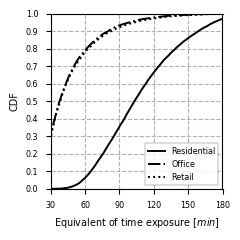
It is obvious Residential produced much worse time equivalence results comparing to the other two, primarily due to higher fuel load density.
Comparing agsint Kirby et al
Time equivalence CDF obtained from Kirby et al is shown in below.
[10]:
print_df(kirby)
| Residential | Office | Retail | |
|---|---|---|---|
| teq | |||
| 30 | 0.169 | 0.464 | 0.404 |
| 45 | 0.193 | 0.647 | NaN |
| 60 | 0.361 | 0.800 | 0.734 |
| 75 | 0.629 | 0.896 | NaN |
| 90 | 0.844 | 0.928 | 0.912 |
| 105 | 0.953 | 0.973 | NaN |
| 120 | 0.991 | 0.982 | 0.968 |
[11]:
fig, axes = plt.subplots(nrows=1, ncols=3, figsize=(2.1*3, 2.5), sharex=True, sharey=True, dpi=100)

for i, case in enumerate(cases_to_run):
    ax = axes[i]
    ax.scatter(kirby.index.values, kirby[case].values, label='Kirby et al', marker='o', facecolors='none', edgecolors='k', linewidths=.8)
    ax.plot(kirby.index.values[~np.isnan(kirby[case].values)], kirby[case].values[~np.isnan(kirby[case].values)], ls='--', c='k', lw=.5)
    ax.scatter(kirby.index.values, dict_func_teq2cdf[case](kirby.index.values), label='SFEPRAPY', marker='^', facecolors='none', edgecolors='k', linewidths=.8)
    ax.plot(kirby.index.values, dict_func_teq2cdf[case](kirby.index.values), ls='-.', c='k', lw=.5)
    format_ax(ax=ax, xlabel='Equivalent of time exposure [$min$]', xlabel_fontsize='x-small', xticks=np.arange(30, 121, 30), xticks_minor=np.arange(30, 121, 15), ylim=(0, 1), yticks=np.arange(0, 1.1, 0.1), legend_title=case, legend_loc=4, legend_fontsize='xx-small', legend_title_fontsize='xx-small')
axes[0].set_ylabel('CDF', fontsize='x-small')

savefig(fig, 'benchmark_1.png')

end